
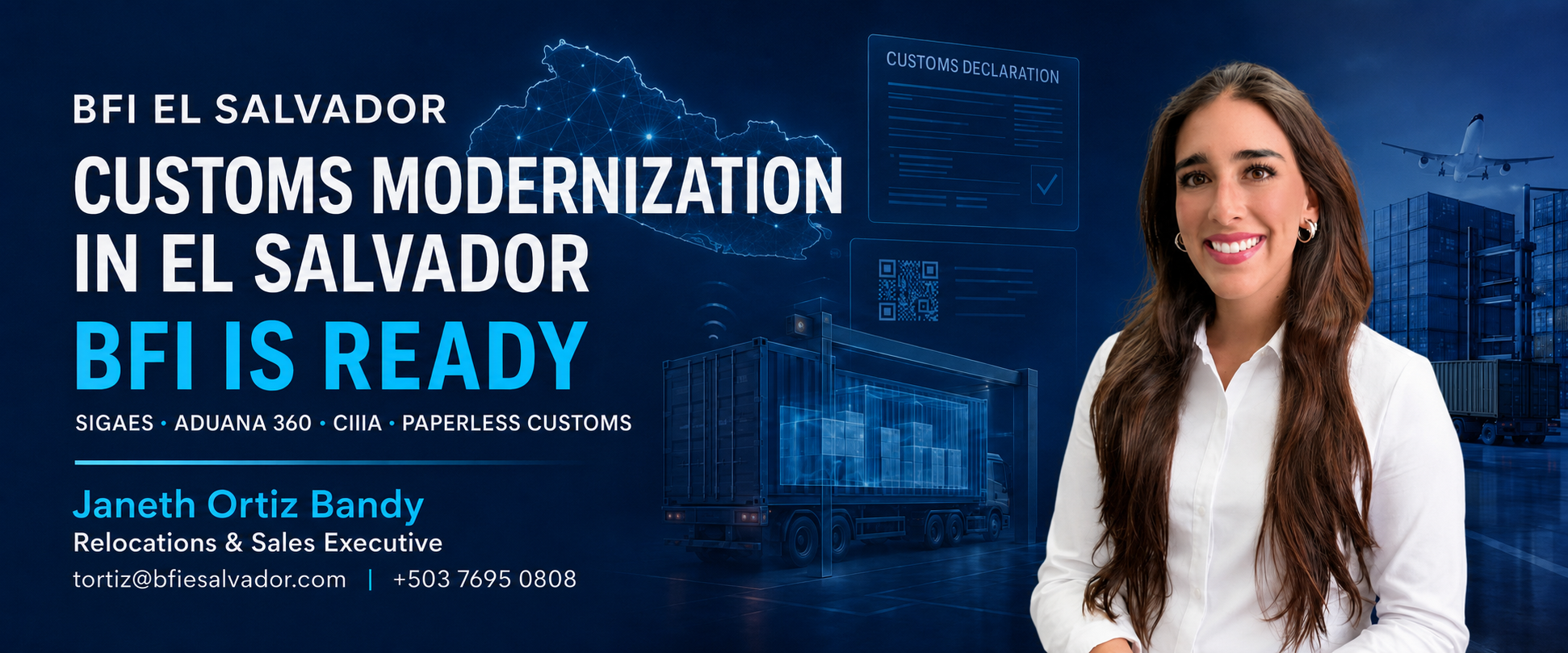
El Salvador is moving toward a more digital, integrated, secure and data-driven customs environment.
The modernization framework presented by the Salvadoran Customs Authority addresses four strategic areas:
- Technological modernization
- Infrastructure modernization
- Simplification of customs processes
- Regional logistics efficiency
For importers, exporters, manufacturers and international logistics partners, these developments represent an opportunity to achieve greater traceability, efficiency and predictability.
They also create new operational responsibilities.
As customs processes become more automated, companies must ensure that product descriptions, tariff classifications, commercial values, certificates of origin, permits and supporting documents are complete and consistent before a declaration is transmitted.
At BFI El Salvador, we closely monitor regulatory, procedural and technological developments to help our clients prepare their operations before cargo arrives.
Explore the Complete Customs Modernization Information
We have prepared two downloadable resources containing additional information about the modernization initiatives presented by El Salvador Customs.
Customs Modernization Presentation
Review the expanded presentation covering SIGAES, Aduana 360, the Integrated Customs Intelligence Center, infrastructure projects, process modernization and regional logistics integration.
[VIEW THE CUSTOMS MODERNIZATION PRESENTATION]
Executive Summary
Download the executive summary prepared by BFI El Salvador, including the four modernization pillars, operational implications, potential risks and recommended actions for companies.
[DOWNLOAD THE EXECUTIVE SUMMARY]
The downloadable documents summarize information presented regarding the customs-modernization roadmap. Companies should always verify current requirements, implementation dates and operational procedures through the official publications of the Salvadoran Customs Authority.
Four Pillars of Customs Modernization
The transformation described in the presentation goes beyond the implementation of new platforms. It involves technology, physical infrastructure, simplified processes and regional coordination.
Companies must prepare their personnel, internal procedures, product data, documentary controls and contingency plans to operate effectively in this new environment.
1. Technological Modernization
Technology is one of the principal components of El Salvador’s customs-modernization strategy.
The initiatives presented include:
- The Customs Management System, SIGAES
- Aduana 360
- The Integrated Customs Intelligence Center, CIIA
- The Trusted Operator Portal
- Artificial-intelligence-assisted customs tools
- Electronic traceability
- Institutional system integration
- Progress toward paperless customs processes
These initiatives are intended to strengthen customs control while facilitating legitimate trade.
SIGAES: A New Customs Management Environment
The proposed Customs Management System, known as SIGAES, is positioned as a central platform for the digital transformation of customs operations.
According to the modernization presentation, its anticipated capabilities include:
- Reduced use of physical documentation
- Electronic management and storage of customs information
- Institutional coordination with entities involved in foreign trade
- Electronic validation of certificates of origin
- Digital management of customs transits and cargo transfers
- Faster processing of rectifications
- Support for high-volume declarations
- Integration of free-zone and DPA operations
- Remote access from different devices
- Greater support for courier and e-commerce operations
The presentation also highlights the possibility of processing declarations containing more than 1,000 items without unnecessary fragmentation.
For companies managing extensive product catalogs, this could create important efficiencies. However, it also increases the need to maintain accurate product databases and consistent tariff classifications.
What Should Importers and Exporters Do?
Companies should review and strengthen:
- Product master data
- Commercial descriptions
- Tariff classifications
- Supplier instructions
- Customs values
- Country-of-origin information
- Free trade agreement documentation
- Permit controls
- Technical product records
- Internal document-approval procedures
- Electronic recordkeeping
- Contingency plans for system changes
A digital system can accelerate a correctly prepared operation, but it can also identify inconsistencies more quickly.
Aduana 360 and Mobile Customs Services
The modernization presentation describes Aduana 360 as an official mobile environment intended to bring together customs services that have traditionally been managed through different systems.
The concept presented includes:
- Importer registration
- Air waybill traceability
- Electronic labels
- Travel declarations
- Vehicle declarations
- Electronic anti-bribery forms
- Electronic SAC services
- Customs Status Verification, VEA
- Spanish and English access
- Availability for Android and iOS
- An artificial-intelligence assistant trained using Salvadoran customs information
A centralized mobile platform could improve access to information and allow users to monitor certain procedures more efficiently.
Nevertheless, companies should maintain controlled document repositories and operational contingency plans during every technology transition.
Paperless Customs Requires Better Information
A paperless customs environment does not eliminate documentary responsibility.
Instead, it increases the importance of accurate electronic records.
Every transmitted field should be supported by commercial, technical and legal evidence. Invoice descriptions, quantities, weights, values, origin records and tariff codes must remain consistent across all documents.
Before cargo departs, importers and exporters should confirm:
- Who is responsible for validating the documents
- Whether the tariff code has been reviewed
- Whether permits are required
- Whether preferential origin can be supported
- Whether the declared value is properly documented
- Whether technical information is available
- Whether all documents contain consistent product information
The best moment to resolve a customs issue is before the shipment arrives.
Integrated Customs Intelligence Center
The Integrated Customs Intelligence Center, CIIA, is presented as another important component of the modernization strategy.
Its purpose is to strengthen real-time customs decisions, inspection capacity, traceability and risk analysis.
Technologies identified in the presentation include:
- High-energy portal scanners
- Low-energy scanners
- Backscatter van scanners
- Portable scanners
- Explosive detectors
- Substance detectors
- Body cameras
- Specialized robotic support
- Videovigilance
- Drones
- GPS monitoring
- RFID controls
- QR traceability
- Centralized radiographic-image analysis
- Artificial-intelligence-assisted customs analytics
- Technical support during physical inspections
More advanced controls can improve security and facilitate the identification of risk.
They also make documentary consistency increasingly important.
The commercial invoice, packing list, transport document and customs declaration should all present the same information regarding the merchandise.
Any unexplained difference may generate additional questions or inspection activity.
2. Infrastructure Modernization
Technology must be supported by adequate physical infrastructure.
The modernization strategy includes developments associated with airports, border crossings, inspection areas and customs-control equipment.
The presentation identifies projects related to:
- Modernized passenger-arrival facilities
- Physical-inspection areas
- Customer-service spaces
- Continuous customs operations
- New infrastructure at La Hachadura
- Modernization associated with El Poy
- Specialized customs and logistics training
- New inspection and surveillance technology
Airport Customs Infrastructure
The new passenger terminal and customs areas described in the presentation incorporate:
- Physical-review areas
- Waiting rooms
- Value-counting facilities
- Customer-service offices
- Technology for safer inspections
- Continuous operations 24 hours a day, seven days a week
- Increased capacity for passengers and merchandise
These developments are intended to provide safer, faster and more efficient customs services.
La Hachadura Border Crossing
The new infrastructure planned for La Hachadura is intended to modernize customs and migration control between El Salvador and Guatemala.
The project seeks to improve the management of:
- Imports
- Exports
- Customs transits
- Tourist movement
- Cargo inspections
- Binational coordination
For companies using land transportation, improved border infrastructure may help reduce uncertainty and increase operational capacity.
However, correct advance documentation will remain essential.
3. Modernization of Customs Processes
The third pillar focuses on simplifying procedures and reducing customs-processing times.
Faster clearance may provide several benefits:
- Greater predictability
- Reduced cargo dwell time
- Lower storage costs
- Better transportation planning
- Improved inventory control
- More efficient use of infrastructure
- Increased regional competitiveness
Nevertheless, faster systems require better preparation.
A missing permit, generic merchandise description, unsupported value or incorrect tariff code may interrupt an otherwise efficient operation.
Companies that review their customs information before shipping will be better positioned to benefit from simplified procedures.
4. Regional Logistics Efficiency
Regional integration is especially relevant for cargo moving between El Salvador, Guatemala and other Central American markets.
The modernization presentation highlights initiatives related to:
- Binational border coordination
- Electronic transit traceability
- Advance cargo control
- Faster DUCA processing
- Coordination at regional ports
- Customs presence closer to the cargo’s origin
- Reduced transit and logistics times
- Improved fiscal control
Integration Between El Salvador and Guatemala
The presentation includes information about the binational operation at the Anguiatú border crossing, where coordinated service seeks to reduce processing times and improve cargo movement.
The complete operational figures and additional context are available in the downloadable presentation.
[VIEW REGIONAL INTEGRATION INFORMATION]
Peripheral Customs and Advance Control
The modernization framework also describes the possibility of Salvadoran customs presence at:
- Puerto Santo Tomás de Castilla
- Puerto Barrios
This model could allow greater cargo control from its origin and improve the coordination of merchandise moving through Guatemala toward El Salvador.
Potential benefits include:
- Advance fiscal control
- Faster DUCA processing
- Improved transit security
- Reduced logistics costs
- Greater cargo visibility
- Better regional coordination
Tariff Classification Before Shipping
Tariff classification is one of the most important decisions in an import or export operation.
It determines more than the applicable customs duty.
An incorrect tariff classification may affect:
- Import duties
- Value-added tax
- Preferential tariff treatment
- Import permits
- Restrictions
- Customs inspections
- Rules of origin
- Statistical reporting
- Supporting-document requirements
At BFI El Salvador, our customs team reviews:
- Detailed product descriptions
- Materials and composition
- Technical specifications
- Commercial use
- Product function
- Country of origin
- Catalogs and photographs
- Safety data sheets
- Manufacturing information
- Suggested tariff codes
- Applicable tariff treatment
- Required permits and restrictions
The Salvadoran Customs Authority authorized an updated merchandise-classification procedure on January 19, 2026.
Depending on the product, the application may require:
- Technical specifications
- Catalogs
- Photographs
- Composition details
- Safety data sheets
- Drawings
- Diagrams
- Manufacturer information
- A physical product sample
The official procedure allows online or in-person filing. The published response time is 10 business days, although the period may be extended when additional investigation or analysis is required.
REVIEW THE OFFICIAL TARIFF-CLASSIFICATION PROCEDURE
BFI can assist clients in organizing the technical information needed for a classification request or advance ruling.
Final tariff-classification determinations remain within the authority of Salvadoran Customs.
Immediate Customs Selectivity Monitoring
After a customs declaration is transmitted, the assigned selectivity result determines the next stage of the clearance process.
Depending on the merchandise and customs regime, the operation may require:
- Documentary validation
- Physical inspection
- Technical information
- Clarification of declared values
- Verification of quantities
- Review of tariff classifications
- Additional supporting documents
BFI El Salvador provides:
- Immediate monitoring after declaration transmission
- Review of the selectivity result
- Documentary follow-up
- Coordination of physical inspections
- Presentation of technical information
- Clarification of values, quantities and tariff codes
- Coordination with Customs and cargo terminals
- Payment monitoring
- Cargo-release coordination
- Continuous status updates
- Transportation and final-delivery coordination
Our objective is to respond promptly and maintain operational control through final cargo release.
Immediate Verification at the Consignee’s Premises
For applicable and authorized operations, Salvadoran Customs publishes a procedure allowing merchandise to be transferred under customs control from the customs office of entry to the consignee’s premises.
The merchandise may then be unloaded and verified at the authorized location, subject to the requirements and controls established by Customs.
VIEW THE OFFICIAL IMMEDIATE VERIFICATION PROCEDURE
BFI can review the operation and help determine whether this procedure may apply to a particular shipment.
Official Digital Customs Services
The Salvadoran Customs Authority currently provides access to several online services, including:
- SIDUNEA World
- Integrated Customs Payment System, SIAP
- Customs Status Verification, VEA
- Electronic payment consultations
- Tariff consultations
- Post-release rectification procedures
- Customs company-status consultations
- Services for free zones and DPA
- Customs classification applications
- Immediate verification applications
How BFI El Salvador Supports Customs Compliance
At BFI El Salvador, customs brokerage is managed by our in-house customs team.
This allows closer coordination among document review, declaration transmission, cargo arrival, customs clearance, transportation, storage and final delivery.
Our customs services include:
- Import customs clearance
- Export customs clearance
- Advance document review
- Tariff classification analysis
- Customs valuation support
- Origin and trade agreement review
- DUCA-D and DUCA-F coordination
- Transit operations
- Temporary imports and exports
- Free-zone and DPA operations
- Management of permits and supporting documents
- Customs-selectivity monitoring
- Physical-inspection coordination
- Customs-observation follow-up
- Cargo release
- Local transportation
- Secure warehousing and distribution
Complete Customs and Logistics Infrastructure
Our customs operation is supported by:
- An office in the cargo area of El Salvador International Airport “Saint Óscar Arnulfo Romero y Galdámez”
- Offices in San Salvador, Santa Ana and Acajutla
- A strategically located 1,100 m² warehouse
- Our own transportation fleet
- Secure cargo handling
- Temporary storage
- Cargo consolidation
- Inventory control
- Local distribution
- Cargo-insurance options
- BASC-certified security procedures
This structure allows BFI El Salvador to manage cargo beyond the customs declaration—from document review before arrival through customs release, transportation, warehousing and final delivery.
Prepare Your Operation Before Cargo Arrival
Before shipping, send us:
- Commercial invoice
- Packing list
- Air waybill, bill of lading or land transport document
- Country of origin
- Detailed merchandise description
- Technical specifications
- Materials and composition
- Product photographs or catalogs
- Estimated arrival date
- Preferred customs regime
- Final delivery location
Our customs team will review the available information and identify the principal requirements before cargo arrival.
Download the Complete Information
For additional information about the modernization framework, technological initiatives, infrastructure projects, regional integration and operational implications, download the complete BFI documents:
These documents provide additional context for management, customs, logistics and compliance teams preparing for changes in El Salvador’s customs environment.
Stay Informed with BFI El Salvador
Customs regulations, digital systems and documentary requirements continue to evolve.
BFI El Salvador monitors official Customs publications, administrative provisions, tariff updates and changes that may affect import, export and transit operations.
With more than 17 years of experience, we combine customs knowledge, technology, operational infrastructure and continuous regulatory monitoring.
Whether your cargo arrives by air, ocean or land, our objective is to help you prepare the operation correctly from the beginning.
Request a Customs Review
CLEAR YOUR CARGO WITH BFI
Send us your commercial invoice, packing list, transport document, country of origin and detailed technical description.
Our in-house customs team will review the operation and identify the principal requirements before cargo arrival.
Janeth Ortiz Bandy
Relocations & Sales Executive
Cell: +503 7695 0808
Phone: +503 2132 3916
PBX: +503 2132 3900
Email: tortiz@bfiesalvador.com
Website: www.bfielsalvador.com
BASC Certified · U.S. Embassy Approved Service Provider · IAM · WCAworld · WCA Relocations · Globalia

Escriba un comentario